Wed, Dec 3, 2025
This coming 25 December, the Christmas Matinee the Concertgebouw Orchestra will be on TV for the fiftieth year, broadcast live by AVROTROS. It’s time to look back on a very special Christmastime tradition.
Radio and television broadcasts
The Christmas Matinee will be broadcast on 25 December at 2.00 p.m. on NPO Klassiek radio by AVROTROS, followed by a television broadcast at 3.00 p.m. on NPO 2. This concert will also be broadcast by Medici TV on 25 December at 9.00 p.m. (CET) and by ARTEon 4 January at 5.30 p.m. (CET).
By Martijn Voorvelt - This article was published (in Dutch) in Preludium, the magazine of the Concertgebouw Orchestra and The Concertgebouw.
It’s all warm and cosy in the house, with the candles lit, a plate of mince pies on the table and the most tantalising smells coming from the kitchen. The TV is on, and from our very own living room, we can enjoy the warm sonorities of the world-renowned Royal Concertgebouw Orchestra. Live from The Concertgebouw! Pour yourself a cuppa tea and sit back!
The Concertgebouw Orchestra’s afternoon concerts on Christmas Day have been broadcast on television since 1975. For the first 25 years, the matinees were under the wing of the Netherlands’ national broadcaster NOS, and Eurovision in other European countries. Incidentally, the Christmas Matinee was already a seasonal fixture since long before 1975, but it wasn’t yet associated with the telly, or even with December 25th.
1888-1968: early days
The orchestra’s very first Christmas Matinee was on Boxing Day in 1888, the year it was founded. Under chief conductor Willem Kes, they played a varied French programme of chamber music, opera excerpts and a cello concerto, closing with Berlioz’s Roman Carnival Overture. Over the next eighty years, there would be frequent if not annual Christmas Matinees, always on Boxing Day, with a huge variety of repertoire. Usually the chief conductor stood at the rostrum; this was Willem Mengelberg from 1895 until 1931, when second conductor Eduard van Beinum took over the matinees. When Van Beinum became chief conductor in 1945, a succession of guest conductors was hired for the matinees (which were now an annual event). After Bernard Haitink became chief conductor in 1961, this way of doing things continued unchanged, at least at for a while.
The year 1969 saw a sudden and double break with tradition: instead of Boxing Day, the Christmas Matinee was on Christmas Day, and with Chief Conductor Haitink himself. For his first Christmas Matinee, he conducted Mussorgsky’s Pictures at an Exhibition, plus music by Bach, Handel and Mozart. A year later, Hans Vonk was wielding the baton, and then the Christmas tradition was paused for four years.
1975-1987: Haitink
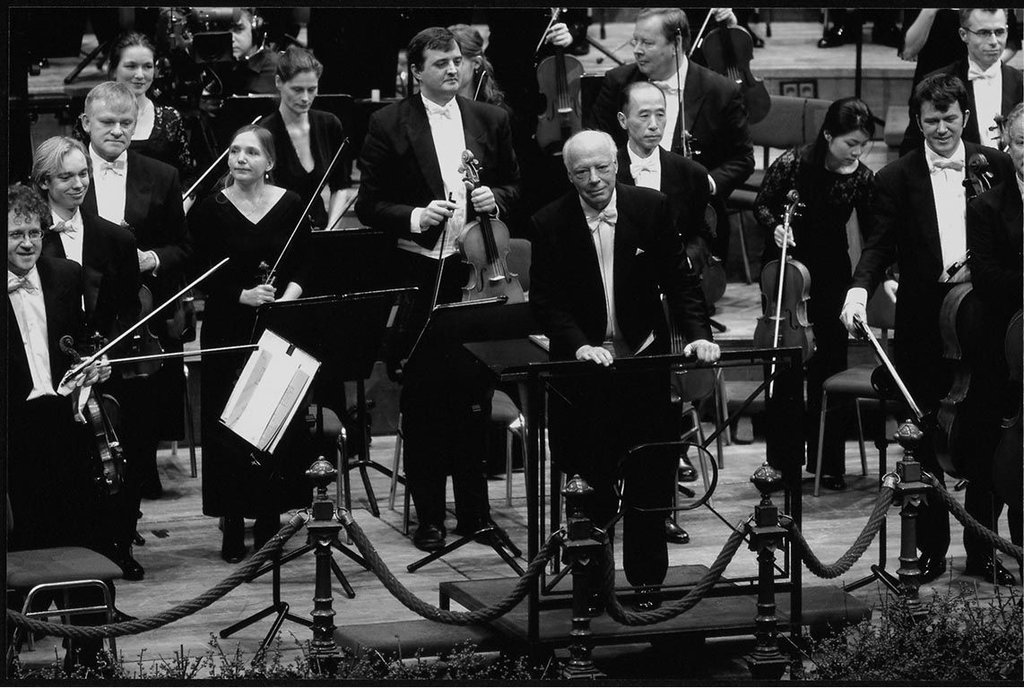
On 25 December 1975, the Christmas Matinee was broadcast live on television for the very first time. The NOS (Dutch Broadcasting Foundation) aired it in the Netherlands, while Eurovision broadcast it in many other European countries. It was the closing event of Amsterdam’s 700th birthday celebration. Haitink conducted Mozart’s Fifth Violin Concerto with soloist Boris Belkin, followed by both suites from Ravel’s Daphnis and Chloe. Besides being a huge success, it was also the birth of a tradition: from then on, conducting the Christmas Matinee was reserved exclusively for the chief conductor.
The Christmas programmes until then had been more of a potpourri of shorter pieces. Haitink highlighted one or two great orchestral masterworks. His Christmas selections included Stravinsky’s The Firebird (1976), Berlioz’s Symphonie fantastique (1979) and Prokofiev’s cantata Alexander Nevsky (1980). His performance of Mahler’s First Symphony in 1977 was the harbinger of a now-legendary series that only began in 1982.
The Eurovision Christmas Matinees gave an enormous boost to both Haitink’s and the Concertgebouw Orchestra’s reputations abroad. The magic only intensified once they drew another great orchestra tradition into their embrace: the bond with Gustav Mahler. In the Christmas Matinees between 1982 and 1987, Haitink conducted Mahler’s Symphonies No. 4, 3, 2, 7, 5 and 9, in that order. His poignant performance of the Ninth, shortly before his farewell as chief conductor, is still a vivid memory for many people. In 2004 Philips released a CD set of all the Christmas Matinee Mahler concerts, and a DVD box set followed two years later.


1988-2003: Chailly
Like his predecessor, Riccardo Chailly took a few years to find his personal forte in the Christmas Matinee. His first one had already been a statement: he had invited the Netherlands Radio Choir, a boys’ choir and three vocal soloists for a performance of Orff’s Carmina burana. It hit the mark, with the NRC newspaper praising Chailly’s nuanced interpretation in his ‘superb debut’.
The Radio Choir would remain a Christmas Matinee constant until 1994, lending their voices to choral masterpieces such as Liszt’s Faust Symphony, Verdi’s Four Sacred Pieces and Janáček’s Glagolitic Mass. The technical (recording and broadcasting) side was taken over by AVRO in 1990 .
Between 1994 and 2000, Chailly conducted exclusively Italian music at the Christmas Matinees. His programmes included operas, primarily with imported Italian specialists singing the solos, and usually the Netherlands Radio Choir. The first concert performance of a complete opera during a Christmas Matinee was on Christmas Day 1996, with I pagliacci by Leoncavallo. It also marked the Concertgebouw debut of the National Children’s Choir, founded in 1989, with whom the Concertgebouw Orchestra still regularly works.
Chailly’s Italian series culminated in a triptych of Puccini one-act operas. Soloists were brought in by the planeload: eight of them for Il tabarro in 1998, fifteen for Suor Angelica in 1999 and just as many in 2000 for Gianni Schicchi. Chailly followed Puccini with a three-year run of ‘Stravinsky’s greatest hits’, kicking off in grand style with the Symphony of Psalms and Oedipus Rex, continuing with Pulcinella and The Rite of Spring in 2002 and Petrushka and The Firebird in 2003.
Despite the Christmas concerts’ unwavering popularity, after Haitink’s departure, the magic had largely faded for those watching from home. Eurovision withdrew, and AVRO paused to reconsider. In 2002, AVRO broadcast part of the concert live, along with recorded selections from the previous year’s concert, and in 2003 it only showed repeats. However, the ties between the orchestra and broadcaster were not so easily broken, and with Mariss Jansons as the new chief conductor, the live broadcasts began again.

2004-2014: Jansons
Unlike Chailly’s flamboyant extravaganzas, Jansons’ Christmas Matinees were balanced programmes of Romantic music with one principal soloist. Highlights from these years include Daniel Barenboim in Brahms’ First Piano Concerto (2004), baritone Thomas Hampson in Mahler’s Songs of a Wayfarer (2007) and soprano Eva-Maria Westbroek in Wagner’s Wesendonck Songs (2010). With his characteristic modesty, Jansons was even happy to step aside for someone else, giving the honours to emeritus Bernard Haitink in 2009 and 2011, and in 2013 to his former student Andris Nelsons.
The starting time of these concerts had varied wildly in all these years. The current starting time of 2:15 p.m. has been in place since Jansons’ last Christmas Matinee in 2014, when he conducted Mahler’s most ‘Christmasy’ symphony, the Fourth.
2015-2019: interim
In 2015, Daniele Gatti (now out of the running for chief conductor) had not yet staked any claims on the Christmas Matinee, so the options for both artists and repertoire were open for these concerts. For three years in a row, the orchestra performed Bach oratorios with top professional choirs, conducted by baroque-music specialists: the Christmas Oratorio cantatas 1-3 with Jan Willem de Vriend and Cappella Amsterdam (2015), cantatas 4-6 with Trevor Pinnock and the Netherlands Chamber Choir (2016), and the B Minor Mass with Philippe Herreweghe conducting his Collegium Vocale Gent (2017).
A period followed of famous pieces from the Romantic repertoire: Tchaikovsky’s The Nutcracker – although a Christmastime favourite par excellence, this was its very first performance at a Christmas Matinee – under Semyon Bychkov, and Beethoven’s Ninth Symphony with Franz Welser-Möst. Along the same Romantic lines, Verdi’s Four Sacred Pieces had been programmed for the 2020 Christmas Matinee, with Fabio Luisi conducting. However, Luisi tested positive for Covid and was unable to travel. The orchestra hurried to ask the 24-year-old Klaus Mäkelä, who had made an impressive debut in September of that year, to replace him (the programme was changed to allow for shortened rehearsal times).


Since 2020: Mäkelä
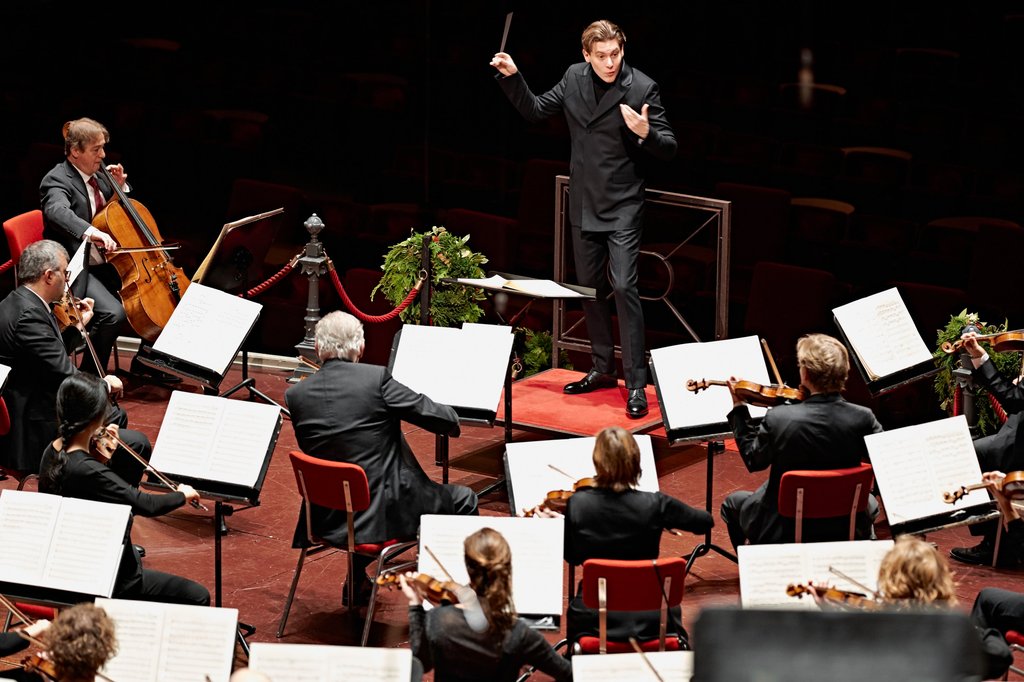
Mäkelä’s first Christmas Matinee was not broadcast live. Instead, it was recorded on 23 December for broadcast on Christmas Day. However, the concert sealed the bond between the Concertgebouw Orchestra and the young Finn. ‘I think that the Christmas Matinee with Debussy’s La Mer and Beethoven’s Sixth Symphony was the point when I felt a closer connection with the orchestra’, he said later in an interview. In the spring of 2022, Mäkelä was appointed chief conductor designate. He will take over the post starting in 2027.
In 2021, the Netherlands was still largely in lockdown, and the previous year’s Christmas Matinee was rebroadcast on NPO 1. In 2022, Myung-whun Chung conducted Mahler’s Fifth Symphony.
Since 2023, the Christmas Matinees have been definitively Klaus Mäkelä’s turf. Fifty years after the first Eurovision Christmas Matinee plus an extra one for Covid, the chief conductor designate is conducting a heart-warming programme of Lydische nacht by Alphons Diepenbrock and Rimsky-Korsakov’s Sheherazade. Who knows whether the coming years will see another tradition-within-the-tradition arising, in the spirit of Haitink’s Mahler concerts or Chailly’s opera series?