Wed, Sep 30, 2026
Ta-ta-ta-tahhh… in October 2026 we’ll play those famous four notes that begin ‘Beethoven’s Fifth’ (as well as the rest of the piece) four times, with conductor Riccardo Minasi. Although these notes are familiar if not iconic today, how would this music have sounded to someone listening for the first time in 1808? Here’s an ‘earwitness’ account of heavy winter coats, exhausted musicians, and the birth of the most famous four notes ever.
By Martijn Voorvelt – this article appeared previously in Preludium, The Concertgebouw and the Concertgebouw Orchestra’s music magazine.
Dear Anton,
I know that it’s hard travelling from Paris to Vienna these days, but you really should have been here last Thursday. Ludwig van Beethoven presented many new pieces during his ‘Akademie’ in the Theater an der Wien.* In particular, his new symphony in C Minor was simply incredible! Do you remember how his Third Symphony blew our socks off three years ago? Now I truly feel that a new era has dawned.
Not that the conditions were ideal. A concurrent event meant that Beethoven had only a few good musicians at his disposal. Also, there was limited rehearsal time, and the heaters weren’t working. We sat there bundled up in our heavy winter coats for four hours! And for all that – not to mention the high ticket price – I would not have missed it for the world.
It was for a good cause, since the proceeds all went to the composer. We all know just how hard the man works, and that his deafness is progressing – I was astonished that he still played the solo in a new piano concerto, and in a closing choral fantasy!** (The latter derailed completely, by the way, but that’s beside the point.***)
The concert began with a ‘pastoral’ symphony – and that was such an overwhelming experience: the music told a story, complete with birdsongs and thunderstorms. But by the beginning of that Symphony in C Minor we had almost forgotten all of it, since we’d heard so many more notes. And as you know, Beethoven’s music isn’t always the easiest on the ears!
Movement I: motif and first theme
The very first notes of that symphony threw us into confusion: it wasn’t C minor at all! It began with a sort of motif in what sounded more like E flat major: a rhythmic motif, ‘pa-pa-pa-pahm’: three short notes followed by a lower and longer one. They played it twice, the second time at a lower pitch.
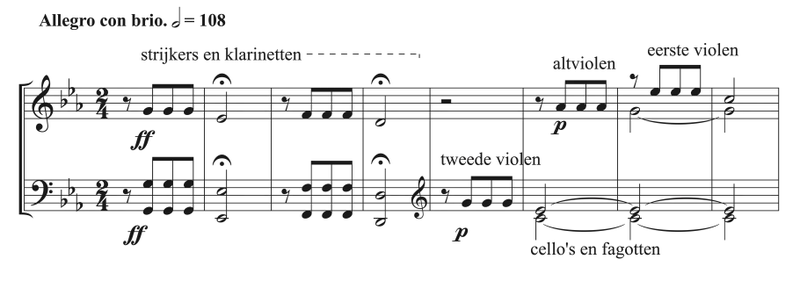
It wasn’t the little motif that was so unusual (I had heard it often already with Haydn and Mozart), but the bold and dramatic way in which it was employed. Bordering on violent. ‘As if fate were knocking at the door’, I overheard someone saying.
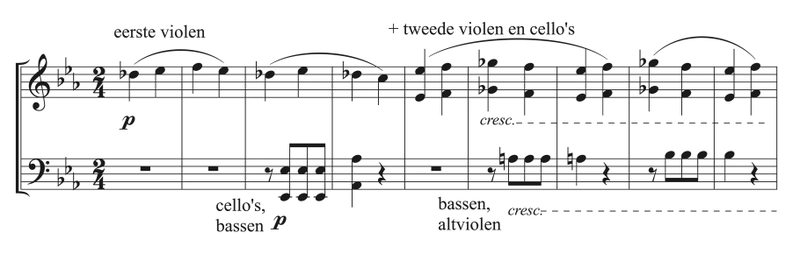
The ominous first theme consisted almost entirely of repetitions of that same rhythmic motif, at different pitches, mostly descending, sometimes rising. Beethoven started building it up by adding instrumental groups one by one. Unbelievably, he simply knitted those little bits together and there it was, a theme! And it was in C minor. But no matter what went on harmonically, that rhythm carried on. You recently saw that new steam engine contraption in England, didn’t you? It was just like that. Very modern!
Movement I: second theme and onwards
As you might expect, the second theme was gentler, more lyrical and in a major key. And yet that rhythmic motif was still there, under the surface. It continually came to the fore and soon it was another steam engine, as if this theme as well was unable to escape its fate.
And the development of the theme? Whew… It went every which way; now and then time seemed to stand still, but then that rhythm would return and you were drawn back into the maelstrom – and thus, almost unawares, we found ourselves at the recapitulation of the first theme. There suddenly turned out to be an additional melody for the oboe, which wrested itself from the orchestra as it were, and became a lovely solo. What an invention!
After the final statement of the two themes there seemed to be a completely new development underway, but it turned out to be no more than an extended coda.
Movements II and III
In the second movement, we left that heavy sense of tragedy and that fateful rhythm behind. This Andante began as a gentle little dance, like a reminder of better days. It was interrupted several times by a triumphal fanfare, after which that little dance kept coming back in a different variation. At the end of each variation, one still heard, briefly, the ‘fate’ rhythm again – subtly, but in two different tempi at the same time!
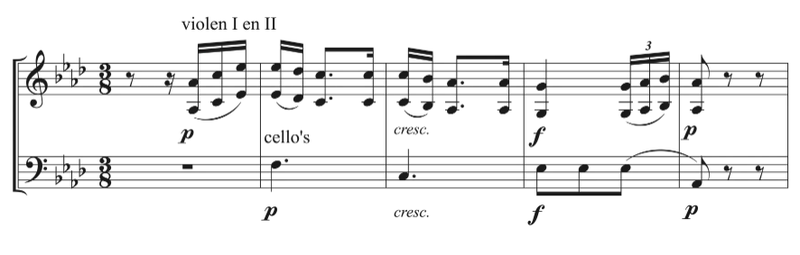
The third movement was entitled ‘Scherzo’, but there was little ‘joking’ to be heard. The tragedy was back, with a vengeance. A menacing melody in the low strings, and then…that’s right, it was back, that rhythm, repeated again and again until it formed a new theme, initiated by the horns.

And yet: now it no longer felt like accepting fate, but more as if we were about to go into battle against it. At that moment it dawned on me – this music is an argument for free will! That’s really the latest thing here these days, the idea that one isn’t a plaything of God’s, or of circumstance, but that one can determine one’s own fate. It’s typical Beethoven too, sullen idealist that he is.
Movement IV
I got it right. The Scherzo magically flowed into the final movement, where a faster version of that rhythmic motif played a role as an ingredient in at least two of the four cheery themes.

The individual had conquered fate: the tragic C minor was now transformed into a radiant C major – and just imagine: with trombones in the orchestra! It all raged on indefatigably, for at least ten minutes I think, until I had the feeling we’d attained a divine status.
Well, ‘divine’ may be overstating it… Afterwards we trudged home, worn out. I’ve heard little talk about it since, but I do hope that it will be performed again, because it’s all just too much to comprehend from hearing a single performance. I also hope that the score will be published soon.**** I have never before heard a symphony in which such a simple rhythmic motif played such a defining role. It forged all the movements into a unity, but because of all the different developments, the motif itself also developed, in the same way a person grows. I know this for certain, Anton, this is the future: from now on, music will be more about the individual, about what takes place in our minds and in our hearts. And more and more music will strive for unity by using a limited amount of material. Don’t you think so too?
Yours affectionately, your friend
Ignaz
* On the evening of Thursday 22 December 1808, Beethoven presented a concert of works that included his Fifth Symphony in C Minor, the Sixth Symphony in F Major ‘Pastoral’ and his Fourth Piano Concerto. At the time, the Fifth Symphony was still called the Sixth and the Fifth was known as the Sixth.
** This was the last time Beethoven would perform a piano concerto as a soloist.
*** The concluding piece, the brand-new Choral Fantasy, op. 80 for orchestra, choir and piano solo, was badly under-rehearsed. It went totally wrong because Beethoven forgot his own instructions, and as a result half of the orchestra repeated the second variation and the other half did not. Despite the cold and general exhaustion, the musicians had to start the piece over again.
**** Only after its publication a year and a half later, followed by an enthusiastic article by writer and critic E.T.A. Hoffmann in the Allgemeine musikalische Zeitung, did the Fifth Symphony begin its triumphal march.


