Interview
Klaus Mäkelä on the St Matthew Passion
Mon, Mar 2, 2026
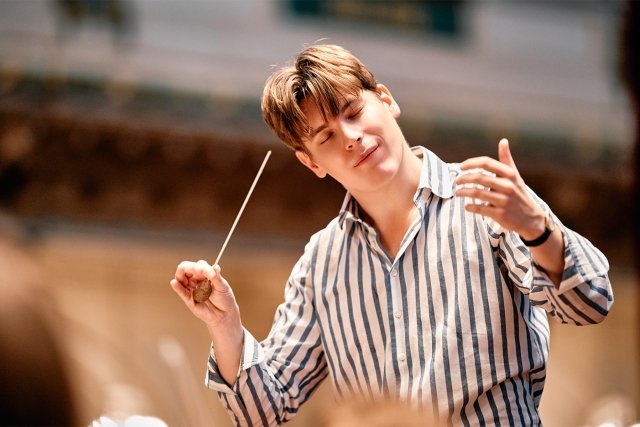
In a very special ‘first’, Klaus Mäkelä will conduct Bach’s St Matthew Passion, both here in The Concertgebouw and in Baden-Baden during the Easter Festival (Osterfestspiele). How will he be approaching this musical monument? And if he were a singer, which of its arias would he most like to sing?
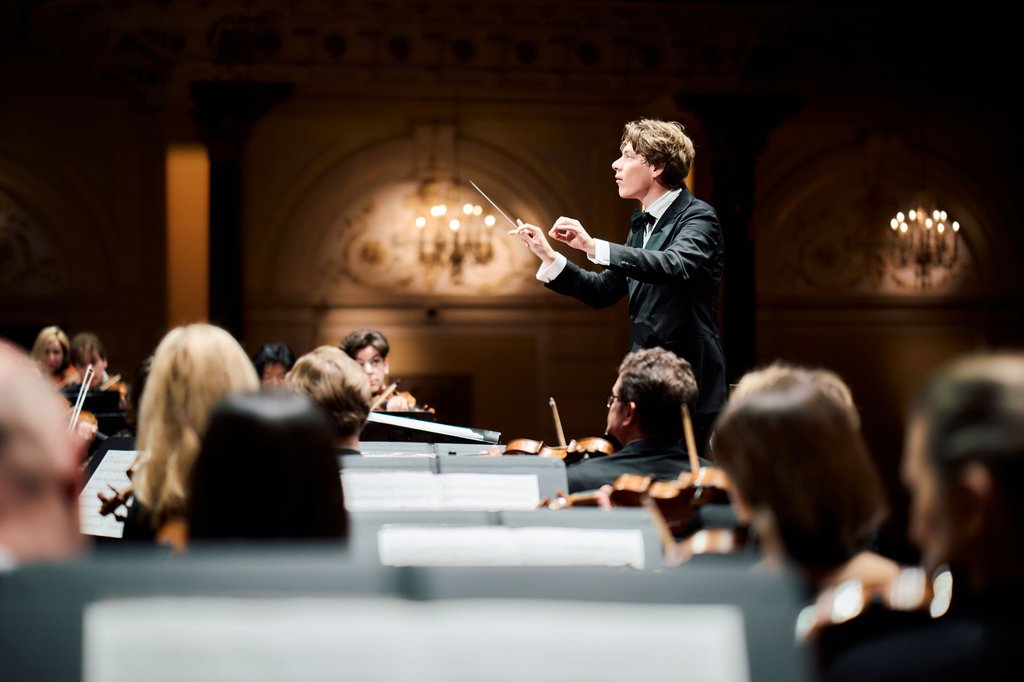
By Martijn Voorvelt – this article appeared in Preludium, the music magazine of the Royal Concertgebouw Orchestra and the Concertgebouw.
There’s a first time for everything. In May of 2025, during the Mahler Festival, Klaus Mäkelä first conducted Mahler’s gigantic Eighth Symphony, and to critical acclaim. Now the Concertgebouw Orchestra’s chief conductor designate is being inducted into another great orchestra tradition: he’s taking on Johann Sebastian Bach’s St Matthew Passion.
As the concerts approach, how do you see this milestone?
‘This will be the next stop of a long journey – well, relatively long – that I’ve taken in the world of Bach. As a cellist, I’ve played the Cello Suites a lot, and other chamber music like the Inventions for violin and cello. I started playing Bach when I was around eight, since it’s really core cello repertoire. Later on, as a conductor, I enjoyed learning about the various ways Bach is performed. Soon I was conducting some of the early cantatas, with various choirs. I’ve also led the Orchestral Suites, with modern orchestras but still as much as possible in baroque style, which I really enjoy. A real high point was getting the opportunity to conduct the B Minor Mass in Oslo [in 2022, ed.] and later in Paris. Joining the Concertgebouw Orchestra’s grand St Matthew tradition is an exciting new step!’
‘I’m especially looking forward to it because the orchestra knows this music so well and has such a good feel for it. That doesn’t mean it’s easy though. There is such a variety of pieces in the St Matthew Passion – choruses, arias, instrumental writing – with a vast range of emotional expression from the most personal, intimate moments to really huge, expressive chorales. How am I going to tackle that? Well, I know more or less what I’m going to do, but since most of the work happens in the week of the performances, I can’t say much just yet – all sorts of things can happen …’
Which of the arias would you like to sing if you were a singer?
‘What a great question – and what an impossible one to answer. This may be unorthodox, but my heart is with the boys’ choir. The opening chorus first evokes such vivid, colourful images, it’s like a massive scene from a Renaissance painting. And then the children’s voices come in like a beam of light from above, in a painting by Raphaël – it’s an incredible moment.’
Listen the St Matthew Passion live
The St Matthew Passion by the Concertgebouw Orchestra will be broadcast live on the radio by AVROTROS via NPO Klassiek on Friday 27 March at 7 p.m. Tickets are still available for the concert in Baden-Baden on Monday 30 March.
‘My heart is with the boys’ choir’
How is it that this music still has so much appeal for us?
‘It offers a universal basis for self-reflection, since the existential questions are the same for us as for people three hundred years ago. A masterpiece like the St Matthew Passion teaches us how to cope with them. The piece tells a story that holds a mirror up to us, and at the same time it’s rich in symbolism. The music is often very poignant and it can be enormously comforting, but it also has these very dramatic, almost shocking moments. It’s simply a timeless masterpiece, one that never goes out of fashion. It hasn’t lost any of its power – in fact, the music actually takes on more meaning with every performance.’
‘When you go to hear one of the Bach Passions, it’s not like going to a normal concert. You get taken on a journey. I hope at least that people will allow us to take them along; we’ll take care of them all along the way, and I hope that they leave the hall feeling cleansed. The St Matthew Passion is a ritual. And nowhere more so than in the Netherlands! I find the Passiontide tradition here really moving, and I feel enormously honoured and grateful that I can participate in that heritage.’
Recently the Willem Mengelberg Society released a beautifully restored recording of the St Matthew Passion from 1939, performed by the Concertgebouw Orchestra under its then chief conductor [Willem Mengelberg, ed.].
‘I can really get into this. I have my own ideas about how you should perform this music but sometimes we get so fixated on our own ideas that we can’t see why other people do it in such different ways. Today we can hear what conductors like John Eliot Gardiner and Nikolaus Harnoncourt have given us, so that now it would be difficult to continue with Mengelberg’s romantic approach, but he was completely sincere and he had good reasons for performing the Matthew Passion that way. A recording like that reminds you to stay more open to people who do things differently than you do. They follow their intuition and they put a lot of thought into it, and even if it isn’t your thing, it can still inspire you.’
Want to read more about the Concertgebouw Orchestra?
Preludium is the magazine for classical music lovers. Have a look
‘We have to stay open to people who do things differently’
Klaus Mäkelä will also conduct the St Matthew Passion during the Easter Festival in Baden-Baden, where he and the Concertgebouw Orchestra will succeed the Berlin Philharmonic as orchestra in residence.
‘Last year was my first performance at the festival. I conducted the Berlin Philharmonic in Richard Strauss’ An Alpine Symphony. I stayed around longer than I needed to, because it’s great festival in a unique and historic location. Baden-Baden was where famous writers and artists hung out; Pierre Boulez lived there until his death. And they have a gigantic hall, the Festspielhaus. The audiences there are really enthusiastic. It’s a real honour that we’re going to follow in the footsteps of the Berlin Philharmonic, but it’s also quite a challenge!’
‘These kinds of longer residencies are really important, since a long-term connection creates a deeper understanding. In a sense I see it as the future of touring. Of course we’ll always give concerts in other halls, but unless you stay in one place for a long time, you don’t really have a relationship with that city and the people, where you become part of the community. And then you can offer a completely different experience than just a one-off concert: you have a much wider canvas to work with. So you don’t have to limit yourself to a miniature; you’re giving the people a big, elaborate painting.’