Background
Conductors on the verge of a breakthrough
Fri, May 29, 2026
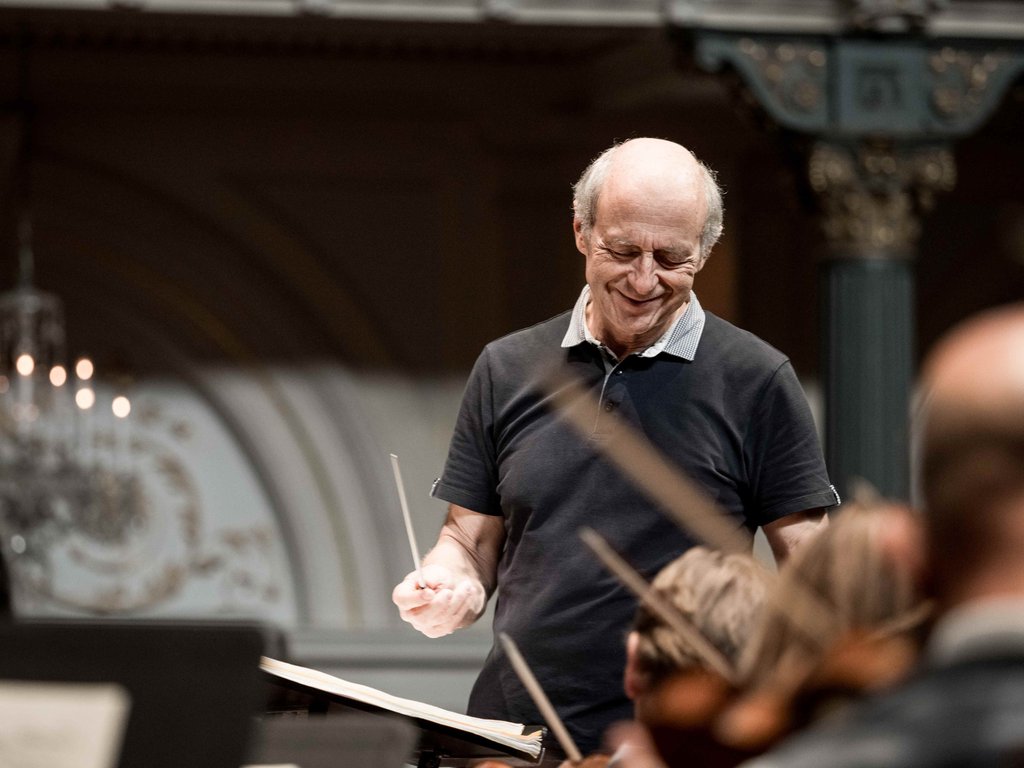
Four promising young conductors are hoping to learn a great deal from Iván Fischer and the musicians of the Concertgebouw Orchestra this month during the Ammodo Masterclass. All four participants characterise this opportunity as ‘a dream come true’.
By Paul Janssen - this interview appeared in Preludium, the music magazine of The Concertgebouw and the Royal Concertgebouw Orchestra.
‘The largest international event for up-and-coming conductors.’ The four participants in the Ammodo Conducting Masterclass are clearly enthusiastic. ‘I’m still amazed that I was selected,’ adds the youngest participant, Maximilian Leicher, adding a few words of his own to the conductors’ collective joy. And Ulysse Derrien from France isn’t hiding his amazement either. ‘Being able to work with an orchestra of the calibre of the Royal Concertgebouw Orchestra is unique. And especially with Iván Fischer supervising; he’s a conductor I really admire.’
Different personalities
China’s Jong-Jie Yin, certainly the most experienced of the four, agrees; he and Camerata Salzburg hit it off, and he already has a concert scheduled with them during the Salzburger Festspiele. ‘It’s sheer luxury being able to work with the Concertgebouw Orchestra,’ he says. ‘And I find Iván Fischer a fantastic mentor and a very inspiring conductor.’
Celia Llácer, from Spain, calls Iván Fischer ‘one of my role models. I was following the Ammodo Masterclass online even before I knew I wanted to be a conductor. It’s a great event for every viewer and listener, because there’s always an interesting selection of candidates, with very different personalities with different techniques and other cultural backgrounds and toolkits.’
For the conductors, the learning experience is far more important than creating a show for the audience. All four are coming into the course with different agendas. Leicher’s is blank. Asked what he expects from the masterclass, he answers, ‘I just want to learn a whole lot, so I’m not coming with a wish list. I’ll do my best, and I’m looking forward to the feedback from the musicians and Maestro Fischer.’
The other candidates stress how remarkable it is that they – as up-and-coming conductors still completing their studies – will be conducting a leading orchestra, working at a level they have not yet experienced before. ‘Your role as a conductor is different,’ Derrien says with certainty. ‘I hope that I can learn what it means to be a conductor at this high a level.’
Luxury car
Jong-Jie Yin and Celia Llácer are also hoping most of all to experience what it’s like to stand at the rostrum before an orchestra of the Concertgebouw’s calibre. Drawing a metaphor, Yin says, ‘I want to learn what it’s like to drive a luxury car. This orchestra is like a Lamborghini. I don’t know if working with it is easier or harder than with other orchestras – I haven’t ever done it yet. I hope I can allow the musicians to really play, and that we have inspiring talks about the music.’
‘And then there’s Iván Fischer’, adds Llácer. ‘I hope to learn everything there is to learn from him. I really look up to that man. The way he makes music is phenomenal. Also, he’s a wonderful pedagogue. I’m very curious about how he approaches a work like Brahms’ First Symphony. I also think it’ll be fantastic to get to know him better from close by. He seems very unpretentious to me, someone who lets the music speak and doesn’t get in the way of the composer. That’s how I’d like to approach the music too.’
This is something she’s already proven that she can do. Although she’s still finishing her studies, she can proudly call herself the Scottish National Orchestra’s assistant conductor. She also comes from Valencia, where ‘music is everywhere’. She continues, ‘I don’t come from a musical family, but I caught the bug from all the music around me. I started with the piano, but when I got to know the symphonic repertoire, I discovered that what I most wanted to do was to connect with people to make music together. Conducting seemed to me to come closest to that idea. It’s crazy: It’s all about communicating with people, but ultimately it’s also a lonesome profession. I’ve learned a lot about myself through conducting.’
Choir boy
The other three conductors did have music in the home. Ulysse Derrien began as a trumpet player. Both of Jong-Jie Yin’s parents are musicians. As a toddler, he was so captivated with James Levine’s movements in a video of him from the Metropolitan Opera that he wanted nothing else but to go along with his father to hear the local orchestra and witness the art of conducting. And Maximilian Leicher had more role models than he could count. As a boy soprano in the renowned Tölzer Knabenchor, he frequently sang with great conductors and internationally famous orchestras. He’s already performed with the Concertgebouw Orchestra, when he sang the role of Yniold in Debussy’s Pelléas et Mélisande with Dutch National Opera in 2019.
From the perspective of his choir-boy experience, Leicher is most looking forward to conducting the Overture to Mozart’s The Magic Flute, the opera he’s sung more than fifty times as a chorus member. Brahms’ First Symphony and Bartók’s The Miraculous Mandarin are also among his favourites. The latter work was welcomed enthusiastically by all the participants. ‘Young conductors don’t often get the opportunity to conduct large-scale pieces like this,’ says Derrien. Jong-Jie Yin is also conducting Bartók for the first time, although he’s looking forward even more to Brahms and especially to Mozart. ‘And to the feedback from Maestro Fischer. Ultimately that’s what it’s all about.’
Gender difference
With this feedback, the conductors hope to put themselves in the spotlight and draw the attention of orchestra managers who follow the masterclass closely. On the importance of the masterclass, Llácer says, ‘We’re all beginning conductors, about to take the next step.’ Derrien adds, ‘The future is always uncertain for conductors. That’s why a high-level event like this is so important, and such a really enormous gift.’
As a woman in a traditionally male-dominated profession, Llácer feels confident about the future. ‘As a female conductor, I’ve had my share of unfair practices and uncomfortable experiences. They shocked me because I grew up in an environment where gender played no role at all. Fortunately, the climate in the profession is clearly changing. Especially for the younger generation, a woman conductor is nothing unnatural. It’s a matter of time, but in my lifetime I’m going to see it generally accepted that talent can come from anywhere, regardless of gender or skin colour.’
The Conducting Masterclass is made possible by Ammodo Art. Ammodo Art supports the development of a new generation of musicians and conductors and the renewal of classical music as an art form.